nikon fm manual
The Nikon FM, introduced in 1977, is a beloved 35mm SLR known for its durability and comprehensive feature set, detailed within its manual.
This camera accepts nearly all Nikon System accessories, offering precision and reliability for both amateur and professional photographers, as explained in the manual.
The Nikon FM’s manual highlights features like a top shutter speed of 1/4000 sec and fast flash synchronization, showcasing its advanced capabilities.
Understanding the manual is key to unlocking the full potential of this classic camera, offering insights into its TTL metering and mechanical shutter systems.
What is the Nikon FM?
The Nikon FM is a 35mm single-lens reflex (SLR) camera, a cornerstone of Nikon’s renowned system, and its manual serves as a comprehensive guide to its operation. Introduced in 1977, it quickly gained popularity for its blend of advanced features and robust build quality.
The manual details how the FM is designed to be compatible with a vast array of Nikon accessories, making it a versatile tool for photographers of all levels. It’s a mechanically controlled camera, offering a tactile and engaging shooting experience, fully explained within the manual’s pages.
Essentially, the Nikon FM, as described in its manual, is a precision instrument built for reliability, offering a full suite of photographic controls in a compact and durable body.
Historical Context and Production Years
The Nikon FM emerged in 1977, representing a significant step in Nikon’s SLR development, with its manual reflecting the technology of the era. It was produced until 1982, establishing itself as a popular choice amongst both amateur and professional photographers.
The camera’s introduction coincided with a growing demand for compact and reliable SLR systems, a context detailed implicitly within the manual’s explanations of its features. The manual itself became a valuable resource for understanding the camera’s capabilities during its production run.
Its relatively short production span contributes to its collectibility today, and the original manual remains a key component for enthusiasts seeking to fully understand and utilize this classic camera.

Nikon FM Specifications
The Nikon FM manual details key technical specifications, including its 35mm film format and durable metal alloy body construction for lasting reliability.
Referencing the manual reveals information on shutter speeds up to 1/4000th of a second and flash sync at 1/250th, showcasing its capabilities.
The manual outlines the camera’s compatibility with the extensive Nikon F-mount lens system, offering versatility for photographers.
Key Technical Specifications
The Nikon FM manual meticulously details the camera’s core specifications. It utilizes standard 35mm film, accommodating a wide range of photographic styles. Shutter speeds range from 1 second to 1/4000th of a second, providing flexibility in various lighting conditions.
Flash synchronization occurs at 1/250th of a second, enabling creative lighting techniques. The camera employs a mechanical focal plane shutter, renowned for its reliability. Its TTL metering system, explained in the manual, offers accurate exposure readings. The Nikon FM accepts Nikon F-mount lenses, ensuring compatibility with a vast lens ecosystem.
The manual also specifies the camera’s dimensions and weight, crucial for portability and handling.
Build Quality and Materials
The Nikon FM manual emphasizes the camera’s robust construction. The body is crafted from a durable metal alloy, contributing to its legendary sturdiness and longevity. This solid build quality ensures the camera can withstand rigorous use and the test of time.
The manual doesn’t explicitly detail specific alloy compositions, but highlights the overall resilience of the materials used. Internal components are similarly built to last, reflecting Nikon’s commitment to quality; This construction provides a substantial feel in hand, inspiring confidence.
The manual implicitly suggests careful handling to preserve this build quality.

Operating the Nikon FM
The Nikon FM manual guides users through essential functions, from film loading to precise shutter speed and aperture control for optimal photographic results.
Mastering these operations, as detailed in the manual, unlocks the camera’s full potential and ensures successful image capture.
The manual provides clear instructions for utilizing the camera’s metering system and achieving accurate exposures.
Loading Film
The Nikon FM manual details a straightforward film loading process. First, open the camera back using the film release lever. Next, insert the 35mm film cartridge into the film chamber, ensuring it seats correctly.
Pull the film leader across the camera and attach it to the take-up spool. Advance the film using the rewind crank until the film perforations engage with the sprocket wheels.
Close the camera back securely. The manual emphasizes proper loading to prevent damage and ensure accurate film advance during shooting. Always rewind the film completely before opening the back.
Setting the Shutter Speed
The Nikon FM manual explains that the shutter speed dial, located on the top of the camera, controls the duration of light exposure. It offers a range from 1 second to 1/4000th of a second, plus a Bulb (B) setting for long exposures.
To set the speed, rotate the dial until the desired value aligns with the index mark. The manual cautions against changing shutter speeds while film is loaded, as it can cause damage.
Understanding the relationship between shutter speed and motion is crucial, as detailed in the manual, for achieving properly exposed and sharp images.
Aperture Control and Depth of Field
The Nikon FM manual details aperture control via the lens’s aperture ring. This ring adjusts the lens opening, influencing both light intake and depth of field – the area in focus. Smaller apertures (higher f-numbers) yield greater depth of field, ideal for landscapes.
Conversely, larger apertures (lower f-numbers) create shallow depth of field, perfect for isolating subjects, as explained in the manual. The manual emphasizes that aperture and shutter speed work together for correct exposure.
Mastering aperture control, guided by the manual, is essential for creative photographic expression.

Metering System
The Nikon FM manual explains its TTL (Through-The-Lens) metering system, offering accurate exposure readings directly from the lens, simplifying photography.
The manual details using the exposure meter within the viewfinder to achieve properly exposed images, crucial for consistent results.
TTL Metering Explained
The Nikon FM manual thoroughly explains the TTL (Through-The-Lens) metering system, a significant advancement for its time. This system measures light after it passes through the lens, providing a far more accurate reading than earlier methods.
Unlike averaging meters, TTL metering considers the specific light affecting the scene as seen by the lens, accounting for filters and close-up attachments. The manual clarifies how the camera reads light reflected from the film plane, ensuring correct exposure.
This direct measurement, detailed in the manual, allows for precise exposure control, especially in challenging lighting conditions. Understanding TTL is fundamental to maximizing the Nikon FM’s capabilities.
Using the Exposure Meter
The Nikon FM manual details how to utilize the camera’s built-in exposure meter effectively. After setting the desired aperture and shutter speed, observe the needle in the viewfinder. A centered needle indicates correct exposure, as explained in the manual.
If the needle deviates, adjust either the aperture or shutter speed until it aligns with the center mark. The manual emphasizes that the meter operates in TTL mode, providing accurate readings through the lens.
Remember to check the battery, as a weak battery impacts meter accuracy, a point highlighted in the manual. Practice using the meter in various lighting scenarios for optimal results.
Focusing Mechanisms
The Nikon FM manual details various focusing screen options and techniques for precise manual focusing, crucial for achieving sharp images with this SLR.
Mastering manual focus, as described in the manual, allows photographers full control over the focal plane and creative depth of field.
Focusing Screen Options
The Nikon FM manual explains that the camera utilizes interchangeable focusing screens, allowing photographers to customize their viewing experience. Several options were available, each designed to aid focusing in different scenarios.
Standard screens offered a balanced view, while split-image and microprism collar options enhanced focusing accuracy, particularly for fast-moving subjects. The manual details how to carefully remove and replace these screens, emphasizing the importance of a dust-free environment to prevent damage to the mirror or shutter mechanism.
Choosing the right screen, as outlined in the manual, significantly impacts focusing speed and precision, catering to individual shooting preferences and photographic styles.
Manual Focusing Techniques
The Nikon FM manual emphasizes mastering manual focusing as crucial for achieving sharp images. It details using the viewfinder’s focusing aids – split-image and microprism collars – to precisely align the subject.
The manual instructs photographers to rotate the focusing ring on the lens until the image appears sharpest in the viewfinder. It also suggests rocking the camera slightly while observing the split-image to confirm accurate focus.
Practicing these techniques, as described in the manual, allows for greater control and creative expression, especially in challenging lighting or with specific subject matter.

Accessories and Compatibility
The Nikon FM manual details compatibility with the extensive Nikon F-Mount lens system, and a wide array of available accessories for expanded functionality.
The manual highlights the camera’s ability to accept virtually any Nikon System accessory, enhancing its versatility for diverse photographic needs.
Refer to the manual for a complete list of compatible lenses and accessories, maximizing the Nikon FM’s potential for creative exploration.
Nikon F-Mount Lenses
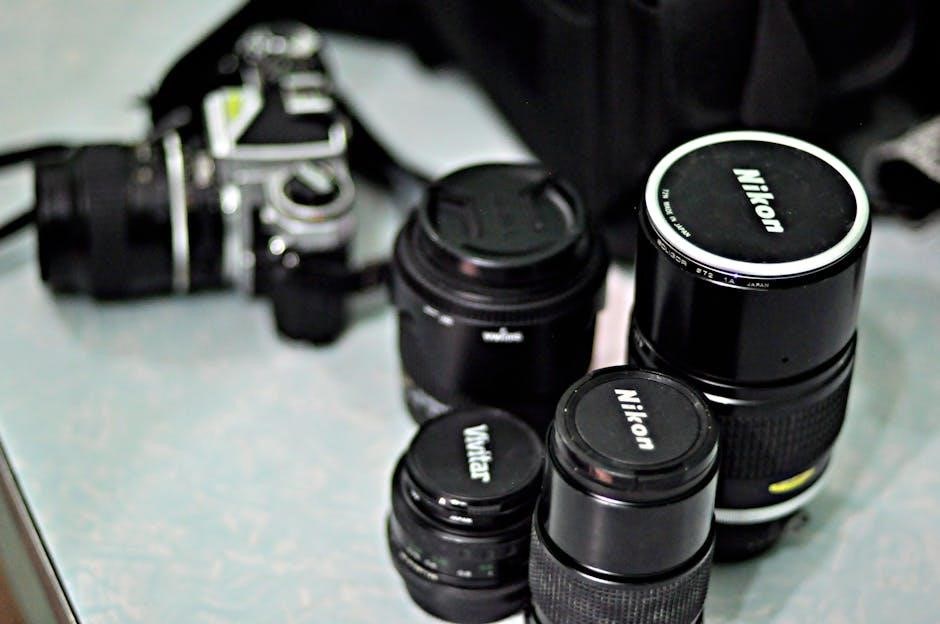
The Nikon FM manual extensively covers the camera’s compatibility with Nikon F-Mount lenses, a system renowned for its breadth and quality. This mount has been a cornerstone of Nikon’s lens design for decades, offering photographers a vast selection of options.
Virtually any Nikon F-Mount lens, both older and newer, can be used with the FM, providing flexibility and allowing photographers to explore different focal lengths and features. The manual details how to properly attach and detach lenses, ensuring a secure connection.
It’s important to note that while most lenses are compatible, some newer lenses with electronic contacts may have limited functionality on the fully mechanical FM. However, the core focusing and aperture control will remain operational, as described in the manual.
Available Nikon FM Accessories
The Nikon FM manual details a comprehensive range of compatible accessories, reflecting Nikon’s extensive system. These accessories significantly expand the camera’s capabilities, catering to diverse photographic needs.
Commonly listed accessories include various finders, motor drives for automated film advance, and external flash units for enhanced lighting control. The manual provides guidance on proper installation and operation of each accessory.
Furthermore, the manual mentions lens adapters, allowing the use of specialized lenses, and remote shutter releases for precise timing. Exploring these accessories, as outlined in the manual, unlocks the FM’s full potential.
Troubleshooting Common Issues
The Nikon FM manual assists in resolving shutter problems and light meter malfunctions, offering diagnostic steps and potential solutions for common operational issues.
Refer to the manual for guidance on addressing these issues, ensuring continued functionality and optimal performance of your classic Nikon FM camera.
Shutter Problems
The Nikon FM manual provides detailed troubleshooting steps for shutter-related issues. A common problem is a slow or inaccurate shutter speed; the manual suggests checking the battery and ensuring proper film loading.
If the shutter doesn’t fire, the manual advises verifying the shutter speed dial is not set to ‘B’ and that the camera isn’t in self-timer mode. Sticky shutter curtains, a potential issue with mechanical cameras, are also addressed, recommending professional servicing if cleaning doesn’t resolve it.
Always consult the manual before attempting any repairs, as improper handling can cause further damage. The manual emphasizes the importance of regular maintenance to prevent these issues.
Light Meter Malfunctions
The Nikon FM manual details troubleshooting for light meter inaccuracies. A primary cause is a weak or incorrect battery; the manual specifies the correct battery type and voltage. If the meter consistently reads incorrectly, the manual suggests checking the film ISO setting, ensuring it matches the film loaded.
The manual also explains how to reset the meter and verify its accuracy against a known good light source. If problems persist, the manual recommends professional calibration, as internal components may require adjustment.
Refer to the manual for detailed diagrams and instructions before attempting any self-diagnosis or repair.
Finding the Nikon FM Manual
The Nikon FM manual is readily available online as a PDF, offering a convenient resource for users. Numerous websites host downloadable versions.
Printed copies may be found through vintage camera retailers or online auction sites, providing a physical reference alongside the PDF manual.
Accessing the manual ensures proper operation and maintenance of this classic camera, unlocking its full photographic potential.
Online Manual Resources (PDF)
Numerous websites provide free PDF versions of the Nikon FM manual, making it easily accessible to photographers worldwide. These digital resources offer a convenient way to learn the camera’s functions and features without needing a physical copy.
ManualLib is a prominent source, hosting the complete Nikon FM instruction manual for download. Several other camera enthusiast sites also archive these valuable documents, ensuring their preservation and availability. A quick internet search for “Nikon FM PDF manual” will yield a wealth of options.
Be cautious when downloading from unfamiliar sources, and always scan files for viruses. These PDF manuals are invaluable for understanding the camera’s operation, troubleshooting, and maximizing its photographic potential.
Printed Manual Availability
Finding an original, printed Nikon FM manual can be more challenging than accessing the PDF versions online. While not readily available at major retailers, these manuals occasionally surface on online auction sites like eBay.
Used bookstores specializing in photography or vintage technology may also carry copies, though availability is unpredictable. Expect to pay a premium for a well-preserved original Nikon FM manual, as they are considered collectible items by some enthusiasts.
Reprinted versions are sometimes offered by third-party publishers, providing a more affordable alternative to sourcing an original. However, quality and accuracy can vary.

Nikon FM vs. Nikon FM2
The Nikon FM2 manual details its faster 1/4000 sec top shutter speed and 1/250 sec flash sync, upgrades absent in the FM manual.
While both cameras share core features, the FM2 manual showcases a more advanced, mechanically-controlled shutter system for enhanced reliability.
Choosing between them depends on your needs; the FM manual suits beginners, while the FM2 manual appeals to those desiring speed and precision.
Key Differences and Upgrades
The Nikon FM2 manual clearly outlines several key improvements over the Nikon FM. Notably, the FM2 boasts a significantly faster top shutter speed of 1/4000th of a second, compared to the FM’s maximum speed. This allows for greater flexibility in bright lighting conditions.
Furthermore, the FM2 manual details its enhanced flash synchronization speed, reaching 1/250th of a second, a substantial upgrade for utilizing flash photography. The FM2 also features a mechanically-controlled shutter curtain, contributing to its renowned reliability, as explained in its manual.
These upgrades, detailed within each camera’s respective manual, position the FM2 as a more advanced and capable machine, though the FM remains a highly respected and functional camera.
Which Model is Right for You?
Consulting both the Nikon FM and FM2 manuals is crucial for making an informed decision. If prioritizing affordability and a fully mechanical experience, the FM, as detailed in its manual, is an excellent choice.
However, if faster shutter speeds and improved flash synchronization are essential – features thoroughly explained in the FM2 manual – the FM2 is the superior option. The FM2’s manual also highlights its mechanically-controlled shutter, appealing to those seeking robust reliability.
Ultimately, both cameras, guided by their respective manuals, offer a fantastic entry point into film photography, catering to different needs and budgets.
Maintaining Your Nikon FM
The Nikon FM manual stresses regular cleaning and proper storage to ensure longevity. Following these guidelines preserves the camera’s functionality and value.
Refer to the manual for detailed instructions on preventative maintenance, safeguarding against common issues and extending the camera’s lifespan.
Consistent care, as outlined in the manual, will keep your Nikon FM operating reliably for years to come.
Cleaning and Storage
The Nikon FM manual recommends gentle cleaning with a soft, dry cloth to remove dust and fingerprints from the camera body. Avoid using harsh chemicals or solvents, as these can damage the finish.
For the lens, use lens paper and cleaning solution specifically designed for photographic optics. The manual advises careful attention to the focusing screen and viewfinder window, keeping them free of debris.
When storing your Nikon FM, the manual suggests a cool, dry place, away from direct sunlight and extreme temperatures. Consider using a camera bag or case for added protection against dust and impacts. Remove batteries to prevent corrosion during long-term storage.
Proper cleaning and storage, as detailed in the manual, are crucial for maintaining the camera’s condition and ensuring its continued functionality.
Regular Maintenance Tips
The Nikon FM manual stresses the importance of periodic checks of the shutter mechanism, ensuring smooth operation without sticking. Lightly lubricating moving parts, as described in the manual, can prevent future issues.
Regularly inspect the light seals for deterioration, as failing seals can cause light leaks onto your film. The manual may offer guidance on replacement or professional servicing.
Avoid forcing any controls; if something feels stiff, consult the manual or a qualified technician. The manual also recommends checking the battery compartment for corrosion and cleaning as needed.
Following these regular maintenance tips, outlined in the Nikon FM manual, will help prolong the life and performance of your classic camera.
The Nikon FM in Modern Photography
The Nikon FM manual guides photographers using this classic camera today, embracing film’s resurgence and appreciating its collector value.
Its enduring quality, detailed in the manual, makes it a reliable choice for modern film enthusiasts seeking a tactile experience.
Understanding the manual unlocks the FM’s potential for contemporary artistic expression and vintage photographic aesthetics.
Using the FM for Film Photography Today
The Nikon FM manual is invaluable for modern film photographers, offering a pathway to mastering this classic SLR. Its fully mechanical operation means no reliance on batteries for core functions, ensuring reliability in any situation.
The manual details how to leverage the FM’s precise metering system and robust build quality for stunning results with various film stocks. Photographers can explore creative techniques, benefiting from the camera’s compatibility with a vast array of Nikon F-mount lenses.
Learning to utilize the FM, guided by its manual, provides a rewarding experience, connecting photographers to the roots of analog photography and fostering a deeper understanding of the photographic process.
Nikon FM as a Collector’s Item
The Nikon FM manual itself is often sought after by collectors, alongside the camera body, representing a piece of photographic history. Its enduring appeal stems from the FM’s robust construction and iconic design, detailed within the manual.
Well-preserved examples, complete with original boxes and manuals, command higher values. Collectors appreciate the FM’s significance as a pivotal camera in Nikon’s lineup, and the manual provides context to its development.
The manual serves as a testament to the FM’s legacy, offering insights into its features and operation, making it a cherished item for enthusiasts and historians alike.